
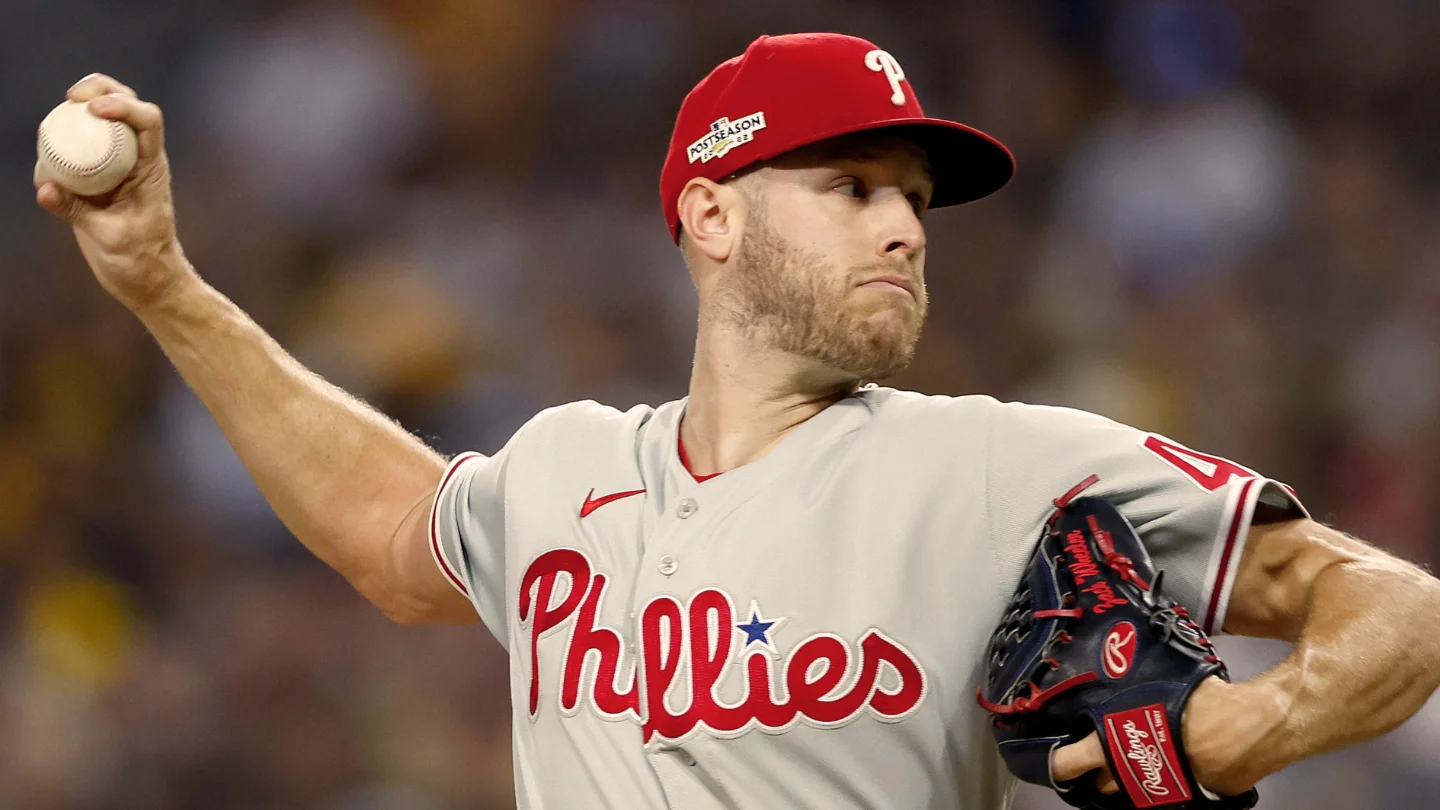
Zack Wheeler is the rare modern ace who makes a Statcast page look as scary as a Red October scoreboard at Citizens Bank Park. He has gone from injury questions and prospect hype to the steady heartbeat of the Phillies rotation, and in 2026, Zack Wheeler’s stats still look more like a pitcher in his prime than one on the decline.
Table of Contents
Rise of Zack Wheeler Within the Phillies Rotation
When Zack Wheeler signed with Philadelphia before the 2020 season, a lot of people saw him as a good number two starter behind the flashier names in the league. Within a couple of years, he turned that narrative on its head and became the guy Phillies fans circle on the calendar as the automatic win day, especially when Citizens Bank Park is rocking in late September.
Since joining the Phillies, Wheeler has posted a 3.06 ERA over his first four seasons in red pinstripes, with 675 strikeouts in 629 and one-third innings, and he led all of baseball in innings pitched in 2021.
That workload tells you everything about how the team views him: when the bullpen is gassed, he is still the one the staff trusts to go seven or eight without blinking. Red October runs in 2022 and 2023 only cemented the feeling that whenever he takes the ball in a big game, the whole ballpark leans forward expecting something special.
The rotation has featured names like Aaron Nola and rising arms like Ranger Suarez, but Wheeler has quietly become the ace around whom everything else is built.
History of a Top Prospect from Georgia to San Francisco
Long before Philly chants echoed his name, Wheeler was the kid from Smyrna, Georgia, lighting up radar guns in high school and rocketing up draft boards. The San Francisco Giants made him the sixth overall pick in the 2009 MLB Draft, banking on the combination of a live fastball and a projectable frame that scouts dream about.
His early years in the minors were filled with the usual growing pains, but the raw stuff had teams around the league watching closely.
A trade to the New York Mets brought him into the New York spotlight, where he flashed top‑of‑the‑rotation potential but also ran into a wall in the form of Tommy John surgery in 2015. Missing two full seasons would have broken a lot of careers, yet Wheeler’s story is defined by what came after that setback.
He returned with stretches of dominance and inconsistency in Queens, but the Mets never fully got the version the Phillies enjoy now. The move to Philadelphia unlocked something different: better pitch usage, more confidence in his fastball, and a coaching staff that trusted him to lean into being the workhorse he always looked like on paper.
The Real Meaning of an Old School Workhorse
In an era when many starters are pulled after two trips through the order, Wheeler has turned himself into the modern definition of a workhorse. He still throws with upper‑90s heat, but the real meaning of his game is stamina and relentlessness.
Hitters know that even in the seventh inning, they might still be seeing 96 and 97 at the top of the zone, not the tired 92 that lets them cheat and sit on something softer.
Statcast numbers show his average fastball velocity sitting comfortably in the mid‑90s, with recent seasons pushing up toward 95 and even above, and a high spin profile that keeps the ball riding through the zone instead of dropping onto barrels.
That lets him pitch deep into games without having to abandon his bread-and-butter pitch. The workhorse tag fits not just because of innings, but because of how he gets those innings: attacking hitters, trusting his stuff, and holding his velocity and command when many starters would already be in the clubhouse.
In a way, he feels like a throwback to the days when Steve Carlton would take the ball and basically tell the bullpen to take the night off, but with all the modern data behind his approach.
The Technical Reality of the Wheeler Fastball and Sweeper
On the technical side, Wheeler is a Statcast dream for pitching nerds. His four‑seam fastball averages around the mid‑90s and has even ticked up in 2024 and 2025, with reports of 96-plus mph averages in certain outings and peak readings above 98.
Baseball Savant data shows that his fastball sits in elite territory for velocity and active spin, which helps explain why hitters have struggled to square it up even as they know it is coming.
The performance results back that up. Opponents have hit barely above the Mendoza line against his four‑seamer in recent seasons, with batting averages around the .200 mark in 2023 and 2024 and dropping even lower in 2025, while slugging percentages have stayed in the low .300s and his put‑away rate has climbed into the high twenties.
That is what a dominant primary pitch looks like in today’s game. Around that fastball, he has built a mix that includes a sweeper and other breaking offerings that carry strong swing‑and‑miss rates, with Statcast showing that his year‑to‑year whiff percentages on breakers sit comfortably among the better starters in the league.
In plain terms, the fastball forces hitters to respect the top of the zone, and the sweeper and other breaking pitches finish them when they start cheating. That is the technical reality behind what fans see as a simple formula at Citizens Bank Park: power in, weak contact or empty swings out.
Rumor’s Noise Vs from His Zack Wheeler Contract Reality
Every big‑market ace eventually becomes the subject of trade rumors, especially when fans of other teams start to dream, but in Wheeler’s case, those whispers run straight into the brick wall of Zack Wheeler’s contract reality. In March 2024, the Phillies announced a three‑year, 126 million dollar extension that starts in 2025 and runs through 2027, giving him an average annual value of 42 million and placing him among the highest-paid pitchers in the game on a per‑year basis.
That extension was not a speculative gamble. By then, he had already delivered a 3.06 ERA over four seasons in Philadelphia, led the league in innings in 2021, and anchored multiple postseason runs. Team owner John Middleton publicly shot down the idea of trading Wheeler by saying he would not move him even for legends like Babe Ruth or Ted Williams, which tells you how the organization views his value.
While the Zack Wheeler contract does not include a formal no‑trade clause, his service time and approaching ten-and-five rights effectively give him veto power over any move, which makes a blockbuster trade storyline fun for talk shows but unrealistic in real life. The man is being paid and treated like a franchise pillar, not a rental piece.
Debunking Myths Regarding Age and Potential Velocity Decline
Once a pitcher crosses into his mid‑thirties, people start watching the radar gun like a stock chart and waiting for the dip. With Wheeler, that expected decline has not arrived.
Statcast data from recent seasons shows that his average four‑seam velocity has actually climbed compared to some earlier years, with spikes where he is averaging north of 96 mph in individual games and still touching the upper 90s deep into starts.
The results match the radar gun. In 2024 he went 16 and 7 with a 2.57 ERA over 200 innings, leading the National League with a 0.96 WHIP and striking out 224 batters, numbers that helped make him a finalist and then a runner‑up in NL Cy Young voting.
In 2025 he kept the ERA in the high twos and maintained a WHIP under one, while his strikeout rate reached the highest mark of his career and opponents hit under .200 against him. Those are not the numbers of a pitcher losing his edge with age.
In the context of 2026, the body of work from 2023 through 2025 argues that his fastball and overall performance have either held steady or improved, and that his mix of strength, mechanics, and preparation is keeping him squarely in his prime rather than sliding down the back side of the curve.
The Truth About the Tommy John Recovery Journey and Durability
Tommy John surgery is a turning point in any pitcher’s career, and Wheeler’s 2015 operation shaped a lot of the early concerns about his long‑term durability. Missing the 2015 and 2016 seasons created a long shadow, and every skipped start since has been interpreted through that lens by nervous fans and headline writers. The actual track record in Philadelphia tells a different story.
After joining the Phillies, Wheeler has been one of the most dependable arms in the league, making 90 starts over the last three regular seasons and piling up innings in a way that only a handful of starters can match. In 2021 he led the majors in innings pitched with over 213 frames, and in 2024 he again logged 200 regular-season innings before adding more in October.
His postseason track record is just as impressive, with an ERA around 2.4 in eleven playoff appearances and at least six innings in most of his starts, including multiple gems during deep October runs.
When you combine that workload with the velocity and command numbers he is putting up in 2024 and 2025, the Tommy John chapter reads less like a permanent warning sign and more like a hurdle he cleared on the way to becoming arguably the most durable front‑line starter in the National League.
Comparing Zack Wheeler with Historical Phillies Pitching Legends
Any time a pitcher dominates in Philadelphia, the comparisons to legends begin. For Wheeler, the names that fans most often throw out are Steve Carlton and Roy Halladay, two aces who defined eras at Citizens Bank Park and the old Vet.
Carlton was the classic left‑handed workhorse of the seventies and early eighties, the kind of ace who could win 27 games for a team that barely scored for him. Halladay arrived in the late 2000s and delivered a perfect game, a postseason no‑hitter, and years of surgical excellence.
Wheeler’s resume is still being written, but it already holds some parallels. In terms of sheer innings and responsibility, his 2021 season, leading the majors in innings pitched while carrying the rotation, echoes Carlton’s load in his prime.
His postseason dominance, with a sub‑3 ERA in October and multiple long outings in high‑pressure Red October games, feels very much in line with what Halladay gave Phillies fans in 2010 and 2011.
Statistically, his recent WHIP and strikeout totals stack up favorably in the franchise record book, and advanced metrics like ERA plus and FIP put him right in the conversation with some of the best seasons ever thrown in a Phillies uniform.
The debate over where he ranks all-time is exactly what makes this era fun for fans, because they are watching someone whose performances can be argued in the same breath as those of iconic names.
Why Sports Analytics Validate Zack Wheeler’s Stats as a Cy Young Perennial
The eye test says Wheeler is an ace, but analytics go a step further and paint him Zack Wheeler Cy Young-level pitcher over the last several seasons. Traditional Zack Wheeler Stats like ERA and wins tell part of the story, but deeper measures such as WAR, strikeout rate, walk rate, WHIP, and quality of contact metrics show just how complete his dominance has been.
In 2024 he put up a 2.57 ERA with that 0.96 WHIP and more than ten strikeouts per nine innings, while holding opponents to a .192 batting average and a .570 OPS, all career bests.
Awards voting reflects that. He finished second in the NL Cy Young race in 2021 and again in 2024, collecting multiple first-place votes and dominating the second-place slots behind different winners, which is exactly what you expect from a pitcher who is in the top tier every single year rather than just peaking once.
Zack Wheeler’s Stats leaderboards reinforce the case, showing him near the top in fastball effectiveness, swing‑and‑miss rates, and suppressing hard contact, while his year‑to‑year metrics remain remarkably stable. When you put all of that together, it becomes clear that Cy Young chatter around Wheeler is not hype, it is the natural outcome of the numbers he keeps putting up.
Final Verdict on the Future Hall of Fame Path for Zack Wheeler
Projecting the Hall of Fame is always tricky, but if Wheeler keeps stacking seasons like the ones he has put up in Philadelphia, his case will be hard to ignore. He already has multiple Cy Young runner‑up finishes, league‑leading innings totals, elite postseason performances, and now a record extension that keeps him in a hitter-friendly park where every dominant start stands out under bright lights.
The key for the next few years is simple. If he maintains a mid‑two to low‑three ERA, keeps the strikeouts high and the WHIP under one, and adds more Red October classics at Citizens Bank Park, he will be building a resume that blends both peak and longevity in a way voters respect.
For Phillies fans, the fun part is that this conversation is no longer hypothetical. Every fifth day in 2026 still feels like a big event when he jogs in from the bullpen, and that is exactly what it feels like when you are watching a pitcher who may one day have a plaque in Cooperstown.