Zip Logic: What UK Volleyball Coaches Really Haul to the Hall Every Week

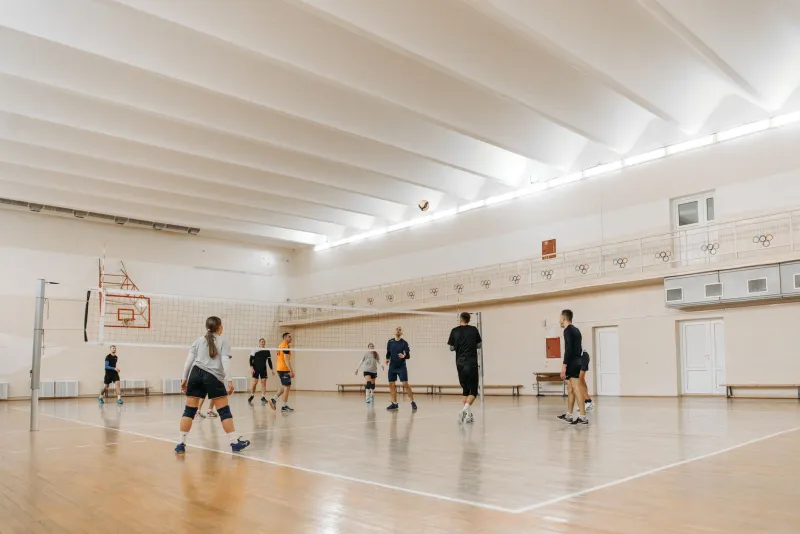
Photo: Gunjan Raj Giri, CC0, via Wikimedia Commons
It is twenty to eight on a Tuesday, the hall lights are doing their usual flicker-and-hum, and a coach is hauling a bag across the floor with the enthusiasm of someone moving a fridge up a stairwell. The zip is half gone. There is a whistle lanyard trailing behind it like a limp flag. Inside that bag is everything a volleyball club is, and a few things it would rather you didn't see.
Talking to coaches across grassroots, junior and national-league setups this autumn, the same theme kept surfacing. Nobody is short of opinions about tactics. Plenty are short of ankle tape. And almost everyone is carrying at least one item that has no business being in a sports hall in 2026.
The Inventory Nobody Puts on the Website
Ask a coach what's in their bag and you get the sensible answer first: balls, pump, spare net, score sheets. Then, unprompted, the real list arrives.
Rolls of zinc oxide tape, mostly half-used. A whiteboard marker that died sometime in October. Safety pins, because bibs and net meshes both fail at the worst moment. A stapler, for reasons nobody can fully explain. A first aid kit with plasters that have gone that particular shade of beige that suggests they predate the current squad. Spare laces. Scissors, usually blunt. A laminated rotation sheet from three seasons ago, kept for luck. Hair bobbles, which for most coaches with a junior section is less an item and more a small textile industry.
Then the sentimental layer: a ball signed by a team that has long since dispersed, a grip of coins for the parking meter outside the leisure centre, and a contactless card that has paid for more post-match teas than the club treasurer knows about.
The bag, in other words, is not a kit list. It is a decision record — a museum of everything a coach has been caught out by and sworn never to be caught out by again.
Three Bags, Three Psychologies
The differences between setups are startling once you start comparing.
The grassroots bag is communal by default. One coach, one bag, and a quiet understanding that it serves whichever two teams are playing that night. Tape is bought by whoever noticed it had run out. It usually contains a spare set of bibs in a colour no league actually uses, and a tube of something that might be Deep Heat or might be very old hand cream.
The junior bag is a different animal entirely. Parent-coaches pack like they are running a small field hospital: labelled water bottles, inhalers, spare socks for the child who forgot theirs, a snack supply with genuine strategic value, and an incident book that is actually filled in. These bags tend to be clean, organised, and heavier than they need to be, because the person carrying them is responsible for fourteen other people's children and knows exactly how quickly a hall booking turns into an awkward phone call.
The national-league bag is where you see preparation become a performance. Assistant coaches, a printed opposition breakdown, a tablet running a stats app, two whistles in case the first one gets a rogue bit of dust in it. The tape is stocked in bulk. There is a spare set of playing kit in a squad member's size, because somebody once turned up in a grey t-shirt and the memory has never faded.
None of these is objectively better. But they do reveal where a club has decided to spend its attention.
The Tangle That Betrays You
There is a small, universal tell: the whistle lanyard.
A tidy lanyard — coiled, clipped, reachable — tends to belong to a coach who has a plan for the warm-up, a plan for the rotation, and a plan for the ten minutes after the final point. A lanyard that has achieved the consistency of a mooring rope usually belongs to a coach whose session plan lives in their head and whose hall key lives in a coat pocket that has never once been checked in advance.
The same goes for the whiteboard marker. Two working pens means someone has thought about the third set. One dead pen and a biro borrowed from the score table means the tactical talk is happening at volume instead.
Small things, sure. But a bag is just preparation you can pick up and carry.
The Emergency Biscuit Doctrine
No audit of coach luggage is complete without the biscuit situation.
Hobnobs show up more than any sports nutrition product. Jaffa Cakes run them close. There is a well-documented phenomenon in UK volleyball where a bag contains a snack supply that is nominally for the players and functionally for the coach on a two-hour away trip that started with a missed junction.
This isn't just comfort eating. Coaches described it as a morale tool. A junior player who has had a bad first set and is quietly spiralling will often come back to the bench for a bit of reassurance — and a biscuit is a far friendlier entry point into that conversation than a clipboard. It is also, more practically, someone's dinner on a night when they came straight from work to the hall.
The bag absorbs all of it: the pastoral, the nutritional, and the slightly chaotic.
What the Bag Says About the Club
Here's the bit that stops being funny and starts being useful.
When a coach is buying tape, pump needles, score sheets and first aid restock out of their own pocket every month, that's not dedication — that's a gap in club admin that will eventually cost you the coach. The clubs that handle this well tend to have a simple system: a shared kit box, a named person responsible for it, and a small annual budget line that nobody has to argue about in February.
You can also read a club's culture in whether bags are shared or hoarded. Teams that pool equipment across sections tend to be teams where a second-team player can be called up without a scramble. Teams where each coach guards their own stash usually have a communication problem hiding somewhere behind it.
And the clubs with genuinely strong identities? Their bags look boring. Everything in them has a home, the tape is where the tape goes, and the spare kit is folded. That's not fussiness. It's the physical evidence of people who have agreed how things work.
Pack Like You Mean It
If this has prompted a reckoning with your own bag, a short and unsentimental checklist for the winter run-in:
- Two working whistles, at least one on a lanyard you can actually find.
- Two fresh board markers and a cloth. Not one. Two.
- Tape, pre-wrap, and proper scissors that cut cleanly.
- Ball pump plus a spare needle — the needle always goes first.
- Printed rotation sheets and a couple of blank scoresheets, because hall printers are a lottery.
- Spare laces, safety pins, and a bin bag for wet kit.
- Coins and a card for parking, because the machine outside the leisure centre has never once worked on a Sunday.
- First aid restocked this season, not in 2019.
- Something for the bench. Interpret that as you wish.
The bag gets dragged in, dumped by the bench, and ignored for two hours while the actual volleyball happens. But it's the most honest document a club produces. Pack it like the season depends on it — because in a cold hall in November, sometimes it does.